It was April 13th, 2026. I parked across from Wawa and walked through the parking lot to what used to be an OfficeMax, now the home to an outpatient internal medicine office. It’s sort of a full-circle moment to be in a former retail space, considering my first job over 2 decades ago was in a Kmart. I was greeted by the front desk staff and directed to a small office complete with a sliding door that read on the outside: “Provider 12.” Over six years ago I quit my full time job, sold my house, and moved into my parents’ basement to start a grueling accelerated pre-med post-bac program. And now I was a fully licensed medical provider. One of the staff introduced herself: “I’m going to be your medical assistant.” What a watershed moment.
It’s been a long time since I’ve published a blog post, a year and a half, actually. I tried many times to write something during clinical year, but could just never finish a post. One reason was that I blinked and the second year of PA school was over. As I was settling into my first ER rotation, I was already gearing up for inpatient internal medicine, then L&D, then surgery, etc.
The other reason is that the first year of PA school is so unbelievable intense, it took me an entire year to come down from it. The second year of PA school is nearly indistinguishable from the first. You get so much of your life back. And I enjoyed every second of that time including the 6 months off I was lucky to have between graduation and employment.
I’ll try my best to bring you up to speed:
When I entered PA school, I had every intention to go into emergency medicine
I did two ER rotations, and a pediatric ER rotation and loved all of them
I really enjoyed my urgent care rotation
If my ER rotation locations had openings, I likely would be working there right now
My last rotation was outpatient internal medicine, and I fell in love with it
I can’t say I’ll miss the screaming children with ear infections
A couple of months ago I started a job as a full time PA-C in outpatient internal medicine
I sort of had an epiphany during my second year of PA school… do I really want to work 12 hour shifts, work overnight, work holidays/weekends? As a 36 year old, that answer became a resounding no. Work-life balance and a predictable schedule are important to me. If I was 26, sure I would throw myself into the trenches of something a bit more fast-paced. Outpatient medicine can be considered fast-paced in its own way; 18-20 patients per day with a mix of acute and chronic care visits, with a geriatric patient population with complex illnesses and laundry list medication and problem lists isn’t anything to sneeze at. You also need to utilize every inch of your medical knowledge. Nothing is off the table (except pediatrics) so you have to be ready for anything. We also have to stay on top of the breakneck bleeding edge of new medications, the latest pharmaceutical commercials that air on basic cable on the weekdays, and the explosive rise of weight-loss drugs. We’re also using AI tools such as Abridge as a digital scribe to help with documentation. All in all, it’s a pretty unique and exciting time to join medicine. But I’m here for the challenge. I’m here for the comprehensive jack of all trades, master of some nature that is primary care.
Right now my schedule is slow, with anywhere from 0-4 patients per day, more commonly on the side of the former. And that’s okay. I know in a few months my schedule will be packed. I try to utilize the lull now to shadow my colleagues, ask questions, scour the depths of DynaMed (which I’ve grown to really like as an alternative to UpToDate), review my school notes, absolutely abuse OpenEvidence, and customize Epic’s Hyerspace with macros and dot phrases.
The learning curve is real. Imposter syndrome is real. But that confidence to be your own provider and trust that you know something but not even close to everything is important. Everyone has to start somewhere. I try not to feel stupid about asking questions but always try to be as independent as possible. I’ll also never lose sight that I’ll never not be a student. I never want to lose that mindset. But even with the breadth of resources out there, the best source is always going to be the provider sitting in the cubicle next to you with 30 years of experience.
Speaking of dot phrases, (which are called SmartPhrases) here’s one I wrote for doxycyline, by far my most common antibiotic prescription so far. It’s truly a master of a medicine considering it covers MRSA, atypical pneumonia, and is a great alternative to those allergic to penicillin/beta-lactams.
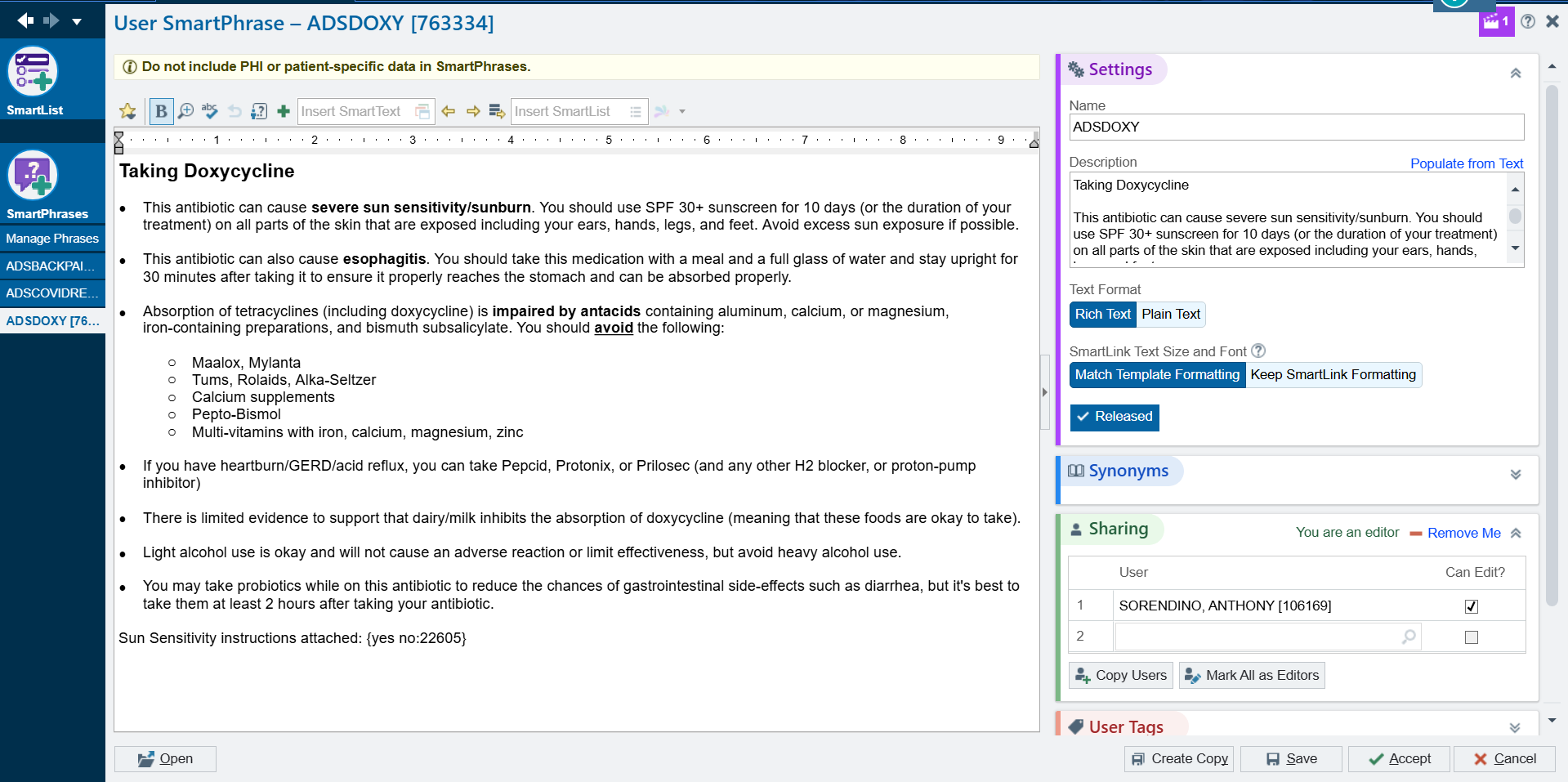
SmartPhrases are really a great bridge between someone who loves writing and teaching and patient care. I look forward to writing a ton of these. The yes no in brackets at the end is known as a SmartList and is just a simple way to input a simple two option field. I use it as a reminder that I need to make an attachment to the patient instructions.
That’s it for now. See you in the next one.
For this post’s song, enjoy Phoenix Arizona’s Sydney Sprague and the absolute bop that is “Flat Circle.” I enjoyed the bass lines so much, I reached out to bassist Chuck Morriss who was kind enough to provide me with a bass tutorial.